
Foam Roofing in Phoenix, AZ
Sprayed polyurethane foam roofing is the best-performing system available for flat and low-slope roofs in Arizona, and it isn’t close. It goes on seamless, so there are no laps or joints to fail. It self-flashes around every penetration. It adds real insulation value on a roof that’s absorbing the full Phoenix sun. And with periodic recoating, it lasts for decades without a tear-off.
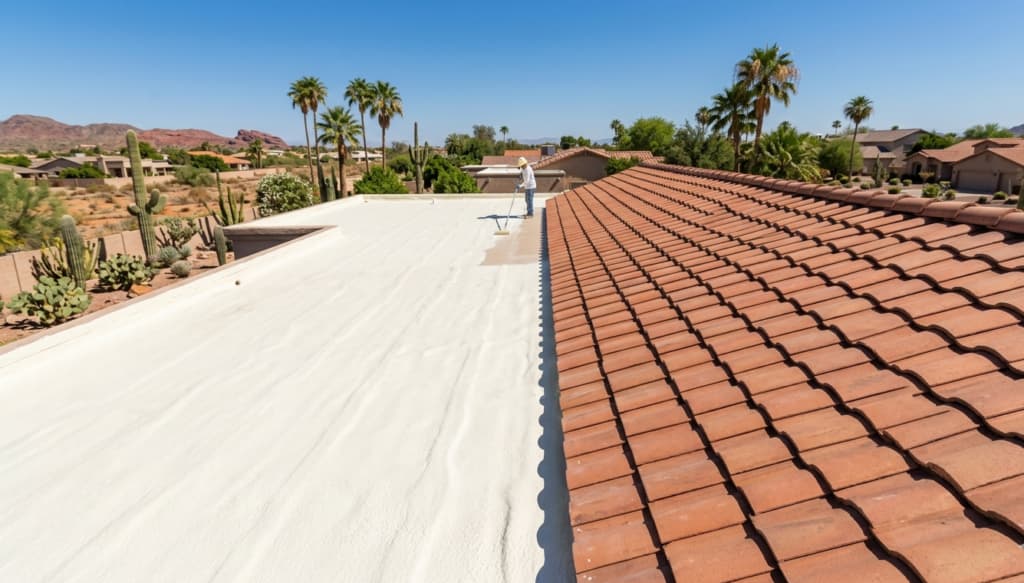
Why Foam Roofing Works Here
No seams. Every other flat roof system is sheets or rolls joined together, and the joints are where they leak. Foam is sprayed as a liquid that expands and cures into one continuous surface. There is nothing to separate.
It self-flashes. Around HVAC curbs, parapet walls, scuppers, vents, and skylights — the foam simply wraps them. On a built-up or modified bitumen roof, each of those penetrations is a hand-detailed flashing that becomes a future leak point.
Insulation value. Roughly R-6.5 per inch. On a Phoenix flat roof taking direct summer sun, that’s a measurable difference in cooling load, not a marketing claim.
It’s lightweight. About 50 pounds per square, versus several hundred for tar and gravel. Meaningful when a structure wasn’t designed for heavy loading.
It can be recoated indefinitely. Every 5 to 10 years the topcoat gets renewed. The foam underneath stays. A properly maintained foam roof can go 30 or 40 years without tear-off, which is what makes the long-run cost so favorable.
The Coating Is Not Optional
This is the thing people get wrong about foam.
Polyurethane foam has excellent structural and thermal properties but poor UV resistance. Left exposed to Arizona sun, it degrades at roughly a quarter inch per year — it chalks, yellows, and erodes.
The elastomeric topcoat is what protects it. That coating is a wear layer, and it has a service life of 5 to 10 years depending on the product and the thickness applied.
A foam roof that never gets recoated will fail. Not because foam is a bad system, but because the maintenance wasn’t done. Most of the “foam roofs don’t last” stories in the Valley trace back to a roof that was sprayed once in 2005 and never touched again.
Recoating is a fraction of the cost of a new roof, and it resets the clock. See roof coating.
- Chalky, powdery residue on the surface, or coating that rubs off on your hand
- Exposed foam — visible yellow or brown foam where the coating has worn through
- Granule loss, if your coating was finished with granules
- Blisters or soft spots underfoot
- Ponding water more than 48 hours after rain
- Punctures from foot traffic, dropped tools, or HVAC service
- It’s been more than 8 years since the last recoat and nobody’s inspected it
Our Foam Roofing Process
- Inspection and moisture survey. We determine whether the existing substrate is dry. Trapped moisture under new foam causes blistering and failure — this step is not skippable.
- Substrate preparation. Removal of wet or deteriorated material, repair of the deck, cleaning and priming. Foam bonds to a clean, sound, dry surface and nothing else.
- Foam application. Typically 1 to 1.5 inches, sprayed to a consistent thickness with slope built in where drainage needs correcting. This is one of foam’s underrated advantages — we can build positive drainage into a dead-flat roof.
- Base coat and top coat. Elastomeric coating applied in two passes at specified mil thickness.
- Granule broadcast. where specified, for walkability and additional UV protection.
- Final inspection, documentation, and warranty. documentation, and warranty.
2 to 5 days for a residential low-slope roof, weather depending. Foam can’t be sprayed in wind above roughly 15 mph or when rain is imminent, so scheduling has some weather flexibility built in.
What Foam Roofing Costs in the Phoenix Area
- New foam roof application: $6.00 – $12.00 per square foot, typically $7,000 – $16,000 on a residential low-slope roof
- Recoating an existing foam roof: $2.50 – $5.00 per square foot
Variables: existing substrate condition, how much wet material has to come off, roof complexity and number of penetrations, foam thickness, and coating specification.
Foam or Something Else?
- Foam is right when you have a flat or low-slope roof, the structure is sound, and you plan to keep the building. The long-run economics are excellent and the performance in this climate is unmatched.
- Foam isn’t right when the substrate is saturated throughout — at that point you’re tearing off regardless — or when the building is being sold in the near term and the buyer will make their own call.
Service Areas
We work throughout the Phoenix metro and surrounding Arizona communities.
Frequently Asked Questions
The foam itself lasts decades. The coating needs renewing every 5 to 10 years. Maintained that way, a foam roof commonly runs 30 to 40 years without tear-off.
Often yes, if the substrate is dry and sound. That’s one of its advantages — no tear-off, no landfill, less disruption. The moisture survey determines it.
Yes, measurably. Roughly R-6.5 per inch of insulation plus a highly reflective coating, on a surface taking direct Phoenix sun.
Yes, with reasonable care. Granulated finishes improve traction. For roofs with regular HVAC service traffic we recommend walk pads along the service path.
Small punctures are simple and inexpensive to patch — the material is seamless, so a repair bonds into the existing surface rather than being taped over it. Get them addressed before water sits in them.
Have it inspected around year 5 and then every couple of years. Chalking, thinning, or any exposed foam means it’s time. Our inspection is free.
Free Foam Roof Inspection
Coating thickness, substrate moisture, and penetration condition — photographed and written up. Most foam roofs we look at need a recoat, not a replacement.