
Flat Roof Repair in Phoenix, AZ
Flat roofs don’t leak randomly. They leak at specific, predictable places seams, penetrations, parapet walls, and scuppers. When you need flat roof repair, we find the actual entry point rather than sealing the nearest suspicious spot.
Signs You Need Flat Roof Repair in Phoenix
- Standing water more than 48 hours after rain. Ponding is both a symptom and a cause — it accelerates deterioration everywhere it sits.
- Blisters or bubbles in the roof surface.
- Seam separation on a modified bitumen or single-ply roof.
- Alligatoring. a cracked, scaly surface texture on built-up roofs.
- Interior ceiling or wall staining. especially near an exterior wall.
- Soft or spongy spots underfoot.
- Staining down an exterior wall below a scupper.
- Loose or lifted flashing at parapet caps.
The Repairs We Do Most in Phoenix
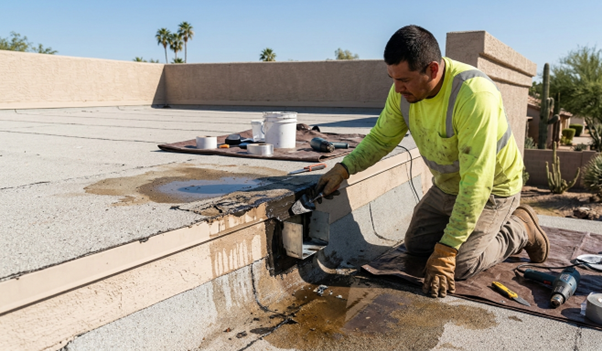
- Parapet walls. The most common source on Valley flat roofs and the most commonly missed. The junction where the roof surface turns up the wall takes constant thermal movement, and the cap flashing on top of the parapet takes direct sun on two faces. Water gets behind a failed cap and runs down inside the wall — which is why these leaks often show up as interior wall staining rather than ceiling drips, and get misdiagnosed as plumbing.
- Scuppers and drains. The through-wall openings that let water off the roof. The sheet metal sleeve corrodes, the sealant around it fails, and the surrounding roof surface is where water concentrates by design.
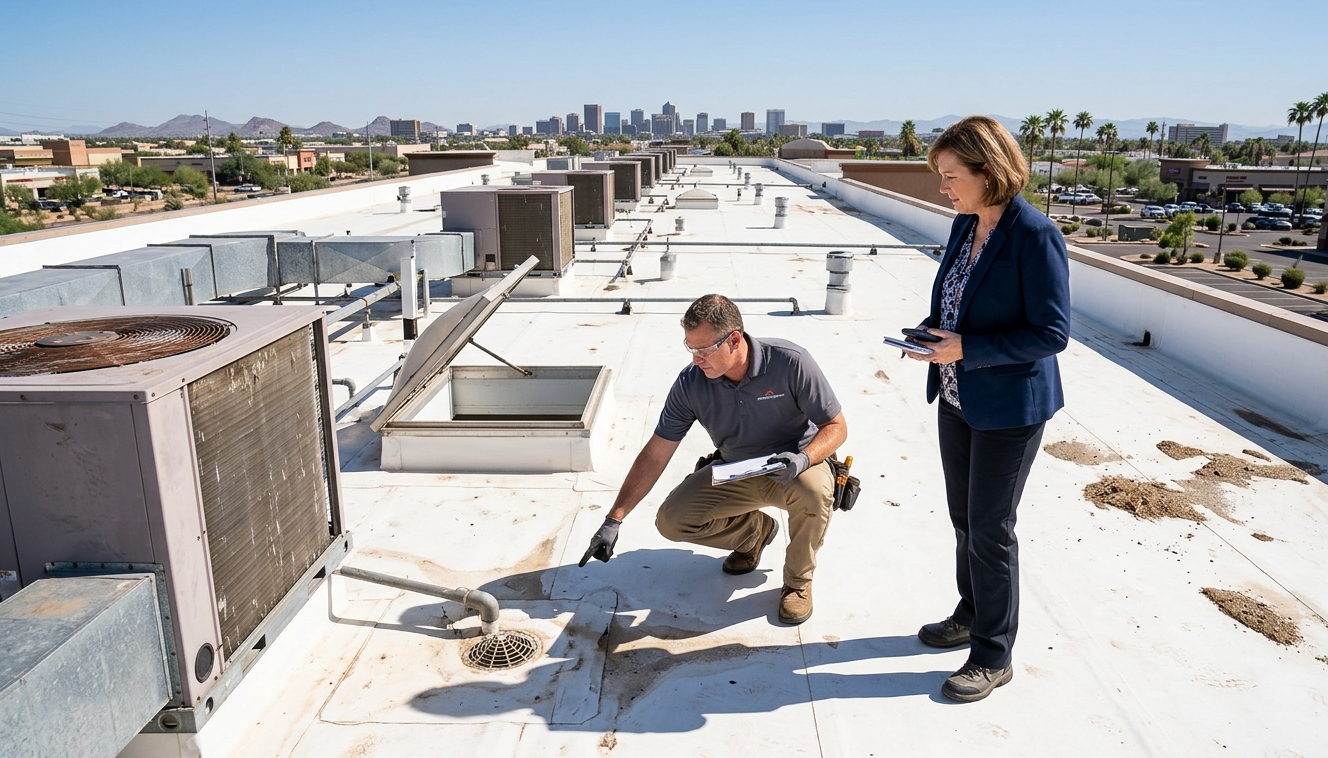
- HVAC curbs. Rooftop units sit on curbed openings, and every one is a penetration. Service techs walk on and around them constantly. The flashing and sealant at a curb takes more abuse than anywhere else on the roof.
- Seams and laps. On modified bitumen and single-ply, every joint is a potential failure point. Phoenix thermal cycling — surface temperatures swinging well over 100 degrees between afternoon and pre-dawn — works those seams relentlessly.
- Ponding areas. Standing water finds any weakness and stays on it. A seam that would shed a passing rain will eventually admit water it’s submerged in for three days.
Systems We Repair
Modified bitumen
torch-down and self-adhered. Seam repair, patching, flashing renewal.
Built-up roof (tar and gravel)
patching, re-flashing, spot repair of alligatored areas.
Single-ply (TPO, EPDM, PVC)
seam welding, membrane patching, termination bar and flashing repair.
Foam (SPF)
puncture and blister repair, spot recoating. See foam roofing.
Coated roofs
recoating over sound substrate. See roof coating.
Our Flat Roof Repair Process
Free inspection. We trace the leak to its actual source. On a flat roof, water can travel a long way between entry and where it appears inside — the interior stain tells us where it landed, not where it got in.
Moisture check. Where the substrate may be saturated, we determine how far it extends. Patching over wet insulation traps the water and guarantees the repair fails.
Photo documentation and written estimate.
Repair, matched to your existing system.
Drainage assessment. If the roof ponds, we’ll tell you what it would take to correct — sometimes it’s a cricket or a tapered section rather than a whole new roof.
Written warranty.
About Ponding
Some standing water on a flat roof after heavy rain is normal. Water still sitting there three days later is not.
Ponding does real damage. It accelerates membrane deterioration, adds structural load (a one-inch pond over 1,000 square feet is about 5,200 pounds), grows algae that holds moisture against the surface, and leaves mineral deposits as it evaporates that degrade coatings.
It’s usually fixable without replacing the roof — a tapered insulation section, an added cricket, or a relocated or additional drain. Worth addressing rather than living with, because everything else on the roof fails faster around it.
What Flat Roof Repairs Cost in the Phoenix Area
- Small patch or puncture repair: $400 – $900
- Seam repair: $500 – $1,500
- Scupper or drain repair and reflashing: $700 – $2,200
- Parapet cap flashing repair: $900 – $3,500 depending on linear footage
- HVAC curb reflashing: $600 – $1,800
- Emergency tarping: $250 – $600
When Flat Roof Repair Isn't Enough
If the substrate is saturated across a large area, if the membrane has failed broadly rather than at specific points, or if you’ve been patching the same roof every year, repair stops being the economical answer.
At that point the options are a foam overlay — which usually doesn’t require tear-off and builds in the drainage correction — or a full replacement. We’ll tell you which, with photos and moisture readings behind it.
Service Areas
We work throughout the Phoenix metro and surrounding Arizona communities.
Frequently Asked Questions
On a flat roof, water enters at one point and travels along the deck or through insulation before it finds a path down. The stain shows where it exited, not where it entered. Tracing that path is most of the diagnostic work.
Yes. Beyond the structural load, everything under and around standing water deteriorates faster. It’s usually correctable without replacing the roof.
Yes. Emergency tarping and stabilization can happen in almost any conditions. Permanent repairs need a dry surface, so we work around the weather.
Two common reasons: the patch went over wet insulation and trapped the moisture, or the original leak was never actually the source. Both are diagnostic failures rather than material failures.
Yes. See commercial roofing.
Sometimes that’s exactly right, if the substrate is sound and dry. Sometimes it’s putting a lid on a wet roof. The moisture survey decides it, not the price.
Free Flat Roof Inspection
We trace the leak to its entry point rather than sealing the nearest suspicious spot, check for trapped moisture, and give you a written estimate with photos.