
Tile Roof Underlayment Replacement in Phoenix, AZ
Your tile isn’t the problem. The tile is doing exactly what it was built to do — concrete and clay tile routinely last 50 years or more in the Arizona sun. What’s failing is the underlayment underneath it, and on most Phoenix-area homes built between 1995 and 2005, it’s already past its service life.
If your home is 20 years old and still has its original underlayment, you’re not looking at a maintenance item. You’re looking at a job that’s already overdue.
Licensed, Bonded
& Insured
Arizona ROC 358748
Free Inspections
Written Warranty
What a Tile Roof Underlayment Replacement Actually Is
The industry calls this a few different things — a tile roof refelt, an underlayment replacement, or a tile lift and relay. They all describe the same work.
Your tile roof is a two-part system. The tile is the armor: it takes the UV, the hail, and the impact. But tile isn’t waterproof — water runs between and under the pieces constantly. The waterproof layer is the underlayment, a membrane installed directly on the roof deck beneath the tile.
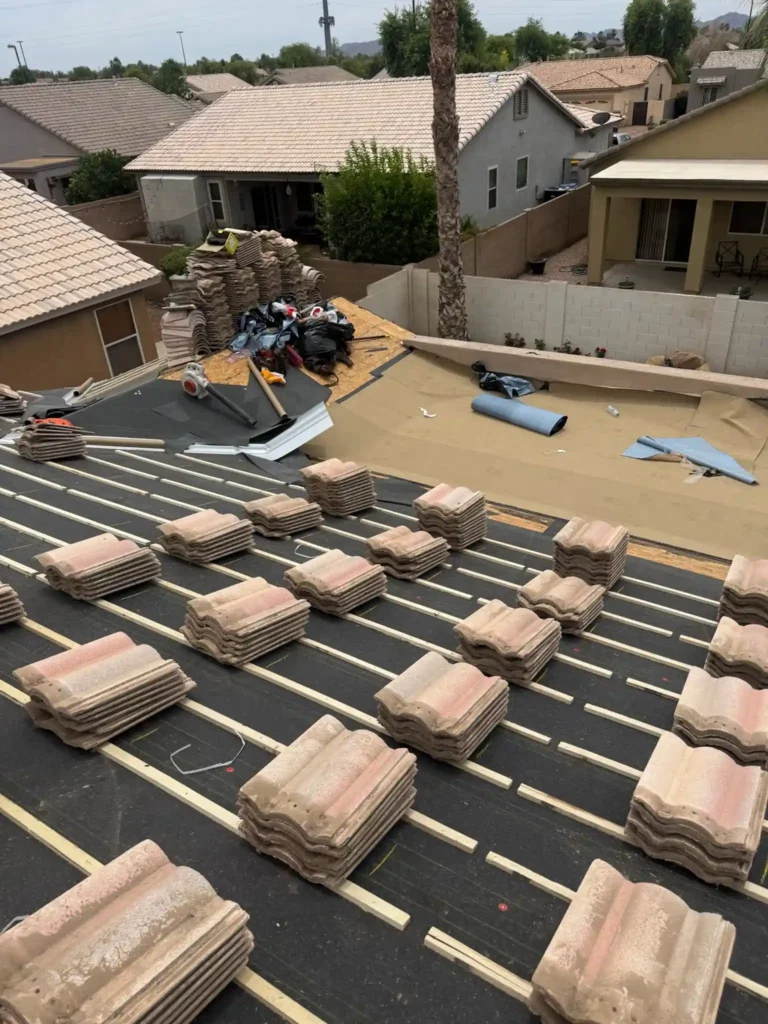
That membrane is the part with the shorter clock. When it fails, we lift and stack your existing tile, strip the old underlayment down to bare deck, repair any rotted sheathing, install new underlayment, and relay the same tile back on top.
You keep your roof’s appearance. You get a new waterproof system underneath it.
Signs Your Tile Underlayment Has Failed
- Black felt paper fragments in your gutters, on your patio, or in the landscaping around your home. That’s your underlayment disintegrating and washing out from under the tile.
- Ceiling stains that appear during heavy rain and then dry out. Because Phoenix only gets around eight inches of rain a year, tile underlayment leaks are intermittent. Homeowners often assume a stain that stops growing means the problem resolved itself. It didn’t — the rain stopped.
- Slipped or sliding tiles, especially in rows near the eaves. When the underlayment and battens degrade, tiles lose their seating.
- Repeated patch repairs that keep failing in different spots. When one area leaks, then another, then another, you’re not chasing individual defects. The whole membrane is at end of life.
- Your home was built before 2006 and has never been refelted. Original 30# felt underlayment in Arizona typically runs 15 to 25 years. Do the math on your build date.
- Visible daylight from inside the attic, or a musty smell in the attic space after a storm.
Why Underlayment Fails Faster in Arizona
Asphalt-based felt underlayment doesn’t fail here the way it does in Ohio. It fails from heat.
A tile roof deck in Phoenix regularly reaches 160°F to 180°F on a summer afternoon, then drops thirty or forty degrees overnight. That daily expansion and contraction cycle runs for months on end, working the asphalt oils out of the felt until the material goes brittle and starts to powder. By year fifteen to twenty, felt that started out flexible has the consistency of a dry cracker.
Then monsoon season arrives. A microburst pushing 60 to 80 mph driving rain doesn’t send water straight down — it drives it sideways, up under tile laps and behind flashings, onto a membrane that no longer has the flex to shed it.
The low rainfall works against you here too. In a wet climate, a failing underlayment announces itself quickly. In Phoenix, water gets past a compromised membrane a handful of times a year, soaks into the deck, and dries. Repeat that for five or six years and you’ve got rotted sheathing and, in some cases, damaged framing — with no visible interior symptom until very late.
Our Underlayment Replacement Process
- Free inspection and documented assessment. We get on the roof, pull tile in several locations to look at the actual condition of the membrane and deck, and photograph what we find. You get the photos whether or not you hire us.
- Written scope and firm pricing. Square footage, underlayment specification, expected tile breakage, flashing and valley replacement, and any deck repair allowance — itemized before work begins.
- Tile removal and stacking. Your existing tile is lifted and stacked on the roof by section. We work in sections so the roof is never fully open, which matters during monsoon season.
- Tear-off and deck inspection. Old underlayment and battens come off down to bare plywood. Every square foot of deck gets inspected. Rotted sheathing is replaced — this is the item most often discovered mid-job, which is why we quote a deck allowance up front instead of surprising you with a change order.
- New underlayment installation. Along with new valley metal, pipe flashings, and wall flashings. Reusing old flashings on a new membrane is a false economy; they’re the first thing to leak.
- Tile relay. Your original tile goes back on. Broken and previously damaged pieces are replaced with matched tile. Expect somewhere between 5% and 10% breakage on a typical relay — that’s normal, and it should be priced into your quote, not billed as an extra.
- Final walkthrough, cleanup, and warranty documentation.
Typical timeline: 3 to 7 days for a standard single-family home, weather depending.
Underlayment Options — And What We Recommend
The traditional option
Two-ply 30# felt
The traditional and lowest-cost option. Realistic service life in Arizona: 15 to 20 years. Fine if you’re preparing to sell, or if budget is the deciding constraint.
Stronger, water-resistant
Synthetic underlayment
Titanium UDL25 and similar. Considerably stronger than felt, doesn’t absorb water, holds up to UV exposure during installation, and carries a Class A fire rating. Typical service life 20 to 25 years, and a common upgrade from standard felt.
Seals around every fastener
Self-adhered high-temperature membrane
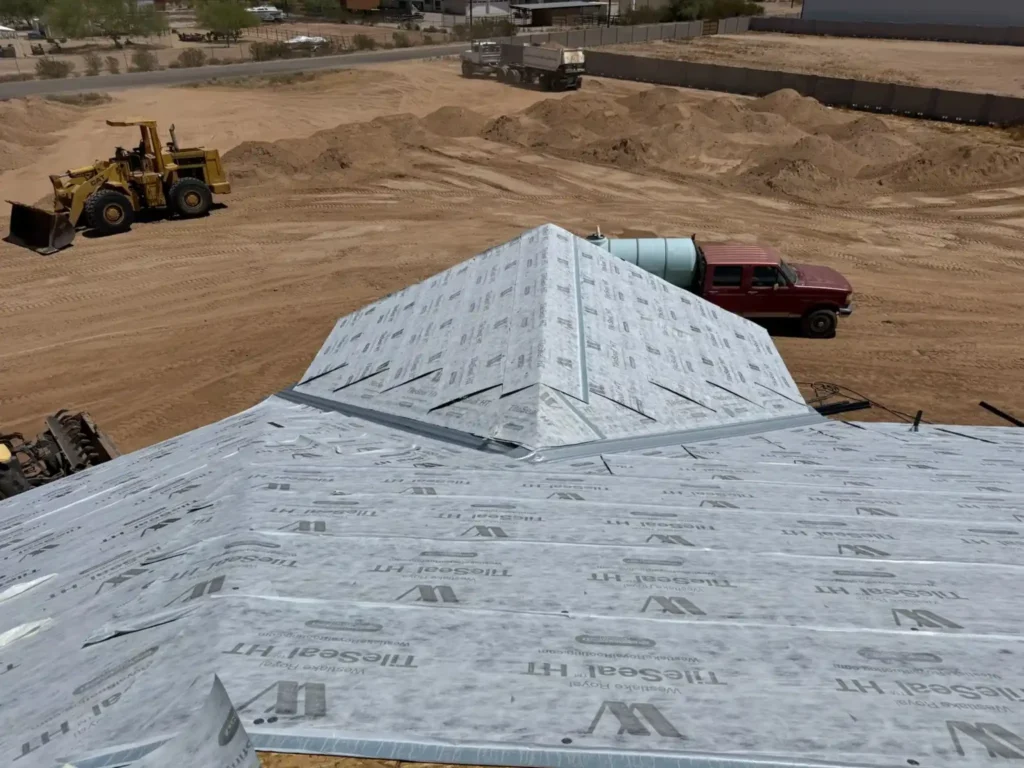
Westlake Royal TileSeal HT (formerly Boral TileSeal), Polyglass Polystick, and similar. These are rubber-modified and self-seal around every nail and fastener, so the fastener holes that eventually let water into a felt system simply aren’t there. They’re rated to far higher temperatures than standard products, carry a 30-year limited warranty, and can sit exposed for months without degrading. Service life 25 to 30+ years.
There’s also a middle option some Valley roofers favor — a heavier felt like TU-43 in two layers, which costs less than a self-adhered membrane and performs comparably. We’ll tell you when that’s the sensible call for your roof.
Built for Arizona heat
What we recommend for most Phoenix homeowners: a self-adhered high-temperature membrane.
The cost difference over felt is meaningful but not enormous, and it roughly doubles the interval before you’re doing this job again. If you plan to be in the house more than seven or eight years, it’s the better economics — you’re paying once to labor the tile off and back on, and that labor is the majority of the job cost. Spending less on the membrane doesn’t reduce the labor you’ll pay again in fifteen years.
We’ll quote whichever you prefer, and we’ll tell you honestly when the cheaper option is the right call.
What Tile Underlayment Replacement Costs in the Phoenix Area
For a typical Phoenix-area single-family home, tile underlayment replacement generally runs in the range of $12,000 to $25,000, or roughly $4.50 to $8.00 per square foot.
The spread is wide because these variables move the number significantly:
Roof square footage
measured on the roof surface, not your home’s floor plan. A 2,200 sq ft house often has 2,800–3,200 sq ft of roof.
Pitch and complexity.
Multiple valleys, dormers, and steep sections slow everything down.
Underlayment specification
Tile type and availability
Concrete tile is straightforward. Discontinued or specialty clay profiles cost more to match for breakage replacement.
Deck condition
The genuine unknown until tile comes off. On a roof that’s been leaking undetected for years, sheathing replacement can add several thousand dollars.
Single story versus two story
Access, staging, and safety requirements.
Refelt or Full Replacement — How to Decide
Homeowners often come to us assuming they need an entirely new roof. Usually they don’t.
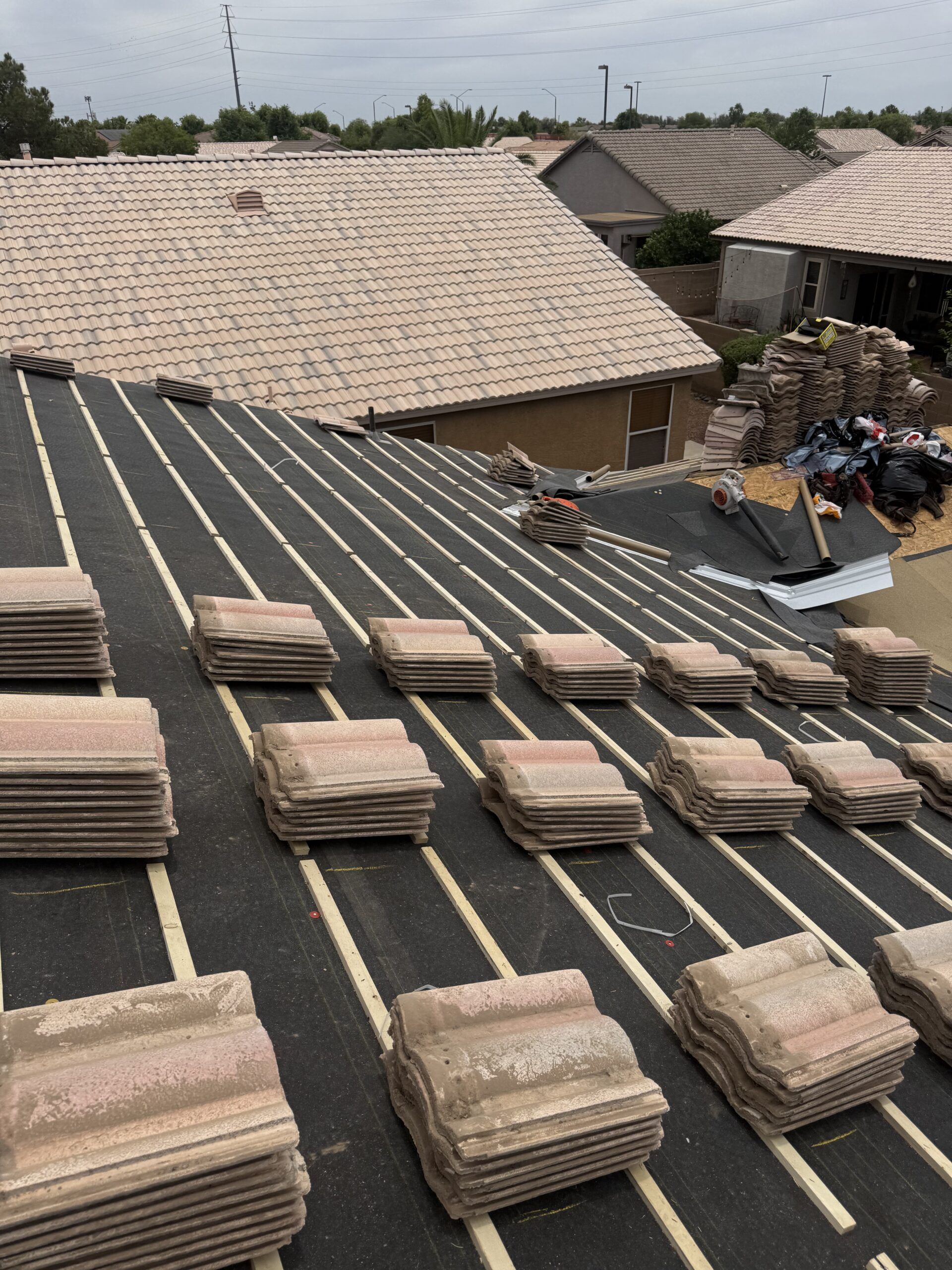
Refelt the underlayment when: your tile is structurally sound, the profile is still available for breakage replacement, and the deck is in reasonable condition. This covers the large majority of Phoenix tile roofs, and it’s a fraction of the cost of a full replacement.
Consider a full replacement when: the tile itself is failing across the roof (widespread cracking, delamination, or spalling on older concrete tile), the deck requires extensive replacement, or you want to change roof systems entirely — for example, converting a low-slope section to foam roofing.
We’ll tell you which one you actually need. If your roof only requires an underlayment replacement, that’s what we’ll quote you.
Related: Tile Roof Repair for isolated cracked or slipped tiles · Roof Replacement for full system replacement
Service Areas
Frequently Asked Questions
Three to seven days for a typical single-family home. Larger or more complex roofs run longer. We work in sections so your roof is never fully open overnight.
Yes. It’s loud — tile removal and relay generate real noise, and you’ll hear it — but the interior of your home isn’t disturbed. If someone in the household works from home or sleeps during the day, tell us and we’ll talk through scheduling.
We reuse your original tile, so the roof looks the same. Broken pieces are replaced with matched tile where the profile is still manufactured. On discontinued profiles we source salvage, and we’ll place any imperfect matches on less visible elevations.
Typically 5% to 10%. Older and more brittle tile breaks more. This should be accounted for in your written quote up front — if a contractor doesn’t mention breakage in the estimate, ask before signing.
Move vehicles out of the driveway, take down anything fragile hanging on walls that share structure with the roofline, and clear patio furniture from directly beneath the work area. We’ll cover landscaping and pool areas.
Generally no. Underlayment failure from age and normal weathering is considered maintenance, not sudden damage, and policies exclude it. If a specific storm event caused damage, that’s a different claim — see storm damage roof repair.
If your home was built before 2006 and the underlayment has never been replaced, it’s time to have it inspected regardless of whether you’re seeing leaks. Our inspection is free and you’ll get photos of your actual deck condition.
Find Out What’s Under Your Tile — Free
We’ll get on your roof, pull tile in several locations, photograph the actual condition of your underlayment and deck, and give you a straight answer about whether you need this work now or have a few years left.