
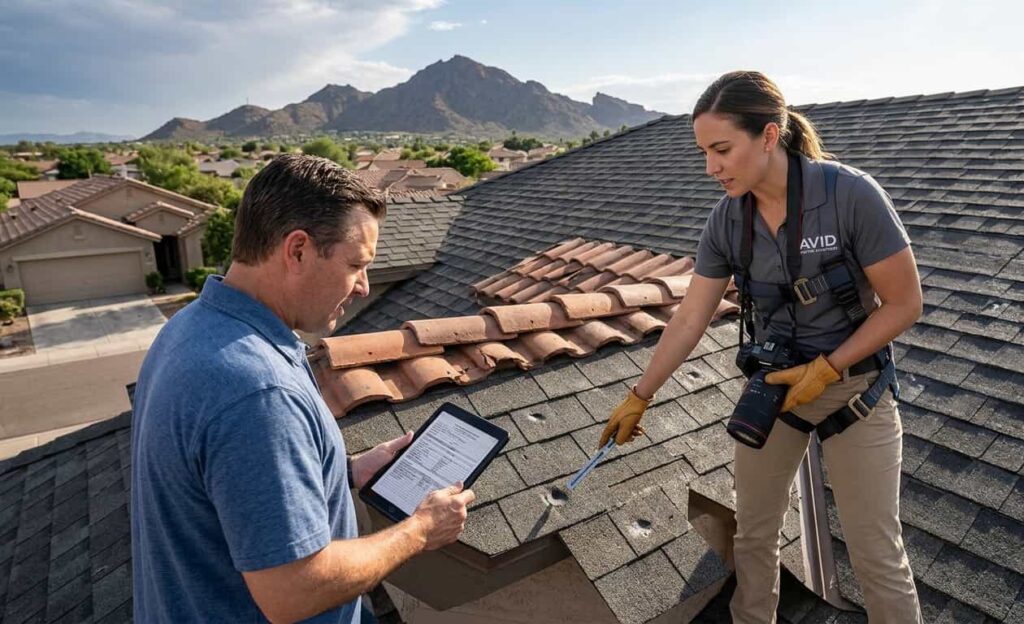
Monsoon season leaves plenty of Phoenix roofs with hail dents, torn shingles, and cracked tiles, and many homeowners assume insurance will cover a full replacement automatically. An insurance claim roof replacement in Phoenix follows a specific process, and understanding it upfront prevents delays and denied claims down the road.
Avid Roofing Solutions works directly with homeowners and adjusters throughout the valley, documenting damage in a way that supports your claim rather than giving the insurance company a reason to push back or delay a decision.
How the Insurance Claim Roof Replacement Process Works in Phoenix?
The process starts with documenting damage as soon as possible after a storm. Photos, a written inspection report, and a clear timeline of when the damage occurred all strengthen your position when the adjuster reviews the file and decides how to proceed.
After you file, the insurance company sends an adjuster to inspect the roof. Have your roofing contractor present during the inspection to ensure the adjuster identifies all storm damage. Contractors can spot areas adjusters may miss, especially on large tile or shingle roofs in central Phoenix or our Gilbert roofing services area.
Once the adjuster completes the inspection, the insurance company issues a scope of work along with a settlement estimate.Compare the insurance scope of work with your contractor’s assessment to identify any gaps.This step helps you identify missed or undervalued damage.
Roof Insurance Claim Process Timeline
Most Phoenix insurers respond within two to three weeks of a filed claim, though severe monsoon seasons with high claim volume can push that timeline out further. Following up regularly keeps your file moving instead of sitting untouched in a queue behind hundreds of other storm-related claims.
Keep a written log of every phone call and email with your insurance company, including the date and the name of each representative you speak with. This record helps you resolve disputes and address unexplained claim delays more effectively.
Common Reasons Insurance Claims Get Denied
Claims get denied for a few recurring reasons: damage attributed to normal wear rather than a storm event, missing documentation, or filing well after the damage actually occurred.Insurance companies review your roof’s age and maintenance history before deciding whether to approve your claim.
A clear inspection report that separates storm damage roof claim issues from pre-existing wear gives you a much stronger position if the insurer pushes back or offers a lower settlement than the actual repair cost would require.
Filing too long after a storm is one of the most preventable reasons for denial. Insurers sometimes argue that a delayed filing makes it harder to confirm the damage was storm related rather than the result of ongoing neglect, so prompt documentation matters more than many homeowners realize.
What to Do If Your Claim Is Denied?
You can request a re-inspection, provide additional documentation, or bring in a second contractor for an independent assessment.Provide clear evidence of storm-related damage to the adjuster or a supervisor to improve your chances of overturning a claim denial.
Arizona homeowners also have the option to file a complaint with the state insurance department if a denial seems unjustified after a re-inspection request. Use this option only when necessary, but keep it in mind to strengthen your position during negotiations with your insurance company.
Working With Your Roofing Contractor and Adjuster
A contractor experienced with residential insurance claims in our Tempe roofing services area speaks the same language as adjusters and knows what documentation carries weight during a review. This partnership often makes the difference between a fair settlement and a lowball offer that undervalues the true scope of repair.
Get every estimate in writing and keep copies of all correspondence with your insurance company. If the settlement offer seems low compared to your contractor’s written estimate, you have solid grounds to negotiate before accepting a number that does not cover the actual cost of repair.
Some contractors offer to meet the adjuster on-site at no extra charge, which is worth asking about directly, since a second set of trained eyes on the roof during the official inspection often catches damage an adjuster moving quickly through several appointments that day might otherwise miss.
Keeping a Storm Season Checklist
Many Phoenix homeowners find it useful to keep a simple checklist ready before monsoon season begins each year, covering their insurance agent’s contact information, their preferred roofing contractor, and a reminder to photograph the roof from ground level before any major storm arrives as a baseline for comparison afterward.
Having this information gathered in advance saves valuable time immediately after a storm, when documenting fresh damage quickly matters most for a smooth, well-supported insurance claim.
Understanding the Adjuster’s Role
An insurance adjuster’s job is to evaluate damage and determine a fair settlement based on your policy terms, but it helps to remember that the adjuster works for the insurance company rather than for you. This does not mean the process is adversarial, but it does mean your own documentation matters just as much as theirs.
Staying polite and professional during every interaction, while still advocating clearly for a fair and complete settlement, tends to produce better outcomes than an adversarial approach. Most claims resolve smoothly when both sides have clear, matching documentation of the damage.
Depreciation and Recoverable Costs
Many insurance policies issue payments in two stages. First, they pay the depreciated value of the roof. Then, they release the remaining replacement cost after you complete the repairs and submit your receipts.Understanding this structure ahead of time prevents confusion when the first check arrives smaller than expected.
This second payment, often called recoverable depreciation, is easy to forget about once repairs are finished. Keep every invoice and communicate with your insurer promptly after the work wraps up so you receive the full amount your policy actually allows.
After the Claim Is Approved
Schedule your roof replacement as soon as your insurance claim for roof replacement in Phoenix is approved. Especially if you live in our Glendale roofing services area or another location at risk of additional storms before the season ends. Acting quickly helps prevent further damage that your original insurance claim may not cover.
Confirm that your contractor has the proper license and insurance before work begins. Ask for warranties on both materials and labor to protect your investment long after your insurance claim is paid and the crew completes the project.
Communicating Clearly With Your Insurer
Every phone call and email should be treated as part of the official record for your claim. Confirm important conversations in writing afterward, even a brief email summarizing what was discussed, so there is a clear paper trail if a dispute arises weeks or months later.
Ask your claims adjuster directly for a copy of the full scope of work and estimate used to calculate your settlement. Reviewing this document line by line alongside your contractor’s own estimate is often the fastest way to spot missing items before accepting a final number.
Choosing Materials Within an Insurance Settlement
Insurance settlements typically cover replacement with a material similar to what was already on the roof, meaning a shingle roof gets replaced with shingle rather than an upgrade to tile at the insurer’s expense. Homeowners wanting to upgrade materials during the claim process usually pay the difference out of pocket.
This is sometimes a reasonable time to consider that upgrade, since a portion of the project cost is already covered by the settlement. Ask your contractor to break out exactly what the insurance payout covers versus what an upgrade would add so you can decide with clear numbers in front of you.
Keeping Records for Future Claims
Once your roof replacement is finished, keep the final invoice, warranty paperwork, and any photos taken during the project in a single, easy-to-find file. This record becomes valuable if you ever need to file another claim in the future or sell your home and need to show recent roofing work to a buyer.
Keep records of all roof repairs, as your insurance company may request them when evaluating future claims or determining whether the damage is new or pre-existing.
Avoiding Common Contractor Scams After a Storm
Storm chasers, meaning out-of-town contractors who show up immediately after a major weather event, are a real concern across the Phoenix area following significant monsoon activity. Avoid signing a contract before you file your insurance claim, as some roofing crews use high-pressure tactics that can complicate the claims process.
Working with an established, locally licensed roofing services provider with a long-standing presence in the valley reduces this risk considerably. Choose a local roofing company with a strong reputation, as it is more likely to honor warranties and provide support long after the repair is complete.
Documenting Damage the Right Way
Photograph every angle of visible damage as soon as it is safe to do so after a storm passes, including wide shots that show the full roof section and close-up shots of individual hail marks, cracked tiles, or torn shingles that clearly illustrate the extent of the problem.
Interior damage matters just as much as exterior damage when it comes to supporting a claim. Photograph water stains on ceilings, damp attic insulation, and any leaks you notice during or after the storm. Record the date you first observed each issue to support your insurance claim.
A written inspection report from a licensed roofing contractor carries more weight with insurers than photos alone, since it translates what a homeowner sees into professional language that matches how adjusters and claims examiners evaluate damage during their own review.
Understanding Your Policy Before a Storm Hits
Reviewing your policy before storm season arrives, rather than after damage occurs, helps you understand your deductible, coverage limits, and whether your policy includes actual cash value or full replacement cost coverage for the roof specifically.
Actual cash value policies factor in depreciation from the start, meaning older roofs receive a smaller payout than a full replacement cost policy would provide. Knowing which type of coverage you carry helps set realistic expectations before you ever need to file a claim.
Homeowners in our Sun City roofing services area and other established, older neighborhoods across the valley should pay particular attention to this distinction, since roof age plays a larger role in payout calculations under an actual cash value policy.
Working With Public Adjusters
Some homeowners choose to hire a public adjuster, an independent professional who represents the homeowner rather than the insurance company, particularly for large or contested claims. Public adjusters typically charge a percentage of the settlement, so this option makes the most financial sense on larger, more complex claims.
For straightforward claims with clear storm damage and good documentation, many homeowners find that working directly with their insurer alongside an experienced roofing contractor is sufficient without the added cost of a public adjuster taking a cut of the final settlement.
Scheduling Repairs During Peak Storm Season
Schedule your roof replacement as soon as your claim is approved, as major storms often increase demand and extend roofing timelines across the valley by several weeks. Booking your repair as soon as approval comes through helps secure an earlier spot in the schedule.
Temporary protective measures, such as tarping an exposed section of roof, are sometimes necessary while waiting for a full repair slot to open up. Most insurance policies cover this emergency mitigation step separately from the main repair, so keep those receipts as well.
What Happens If New Damage Occurs Before Repairs Begin
Arizona’s monsoon season can bring multiple storms in a single summer, and additional storms may damage your roof before you schedule approved repairs. Document any new damage separately with its own date and photos, since insurers generally want each damage event tracked individually rather than combined into one vague description.
Contacting your insurer promptly about new damage, even while an existing claim is still open, helps avoid confusion later about which storm caused which specific area of damage on the roof.
Document your roof damage properly from the start to help your insurance claim for roof replacement in Phoenix move faster and receive a fair payout.. Avid Roofing Solutions helps homeowners through every step, from the first inspection to the final installation, so reach out before your next storm turns into a drawn-out claim.
Frequently Asked Questions
Does homeowners insurance cover roof replacement after a storm in Phoenix?
Most insurance policies cover storm and hail damage, but your coverage depends on your policy terms and whether the damage resulted from a storm rather than normal wear and tear.
How do I file an insurance claim for roof damage in Phoenix?
Document the damage with photos, get a professional inspection report, and file with your insurer as soon as possible after the storm occurs.
What if my insurance company denies my roof claim?
You can request a re-inspection, submit additional documentation, or get an independent contractor assessment to support an appeal with your insurer.
How long does an insurance roof claim take to process?
Most claims in Phoenix take two to three weeks, though busy monsoon seasons can extend that timeline due to higher overall claim volume.
Should I get my own roofing estimate before the adjuster visits?
Yes. Get an estimate from your own contractor to help identify all damaged areas during the adjuster’s inspection and support a fair settlement for the full scope of repairs.
What is recoverable depreciation on an insurance roof claim?
Your insurance company releases the second payment after you complete the repairs and submit your receipts. This payment covers the difference between the depreciated value and the full replacement cost.
Can I upgrade my roofing material during an insurance claim?
Yes, though the settlement typically only covers a like-for-like replacement, meaning you would pay the difference out of pocket for an upgraded material.
How do I avoid storm chaser scams after a monsoon?
Work with an established, locally licensed roofing company with a long-standing presence in the area rather than an out-of-town crew offering immediate, high-pressure deals.
Is it worth hiring a public adjuster for a roof claim?
It depends on the size and complexity of the claim. Public adjusters typically make the most sense for larger, contested claims rather than straightforward, well-documented ones.
What is the difference between actual cash value and replacement cost coverage?
Actual cash value factors in depreciation based on roof age, while replacement cost coverage pays to replace the roof without subtracting for age or wear.