
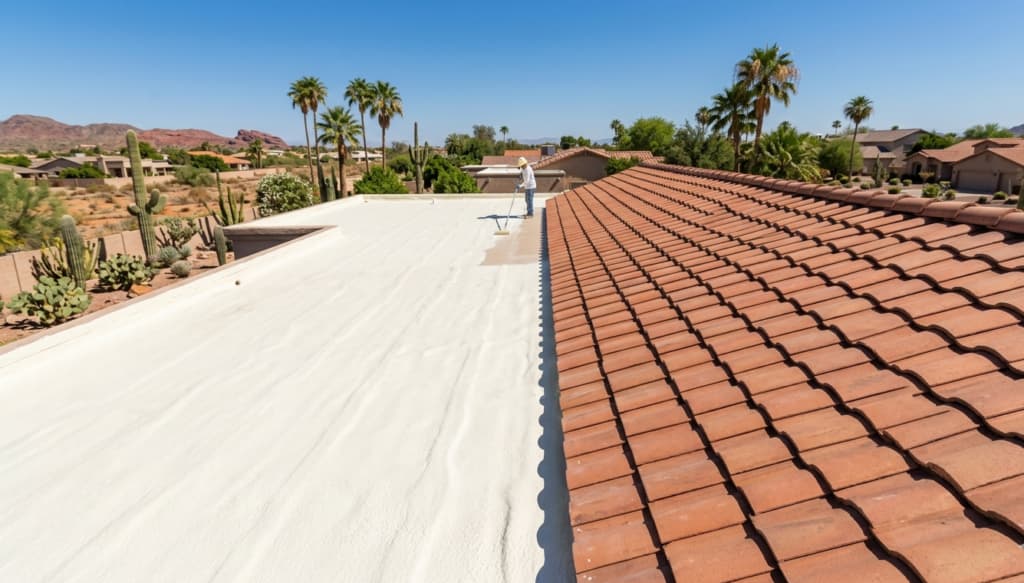
If you live in the Phoenix metro area and you are replacing your roof, two options keep coming up: foam roofing and tile roofing. Both can handle Arizona heat, but they work very differently and cost very differently too. This guide breaks down the real numbers, the real tradeoffs, and what most roofing companies do not bother to explain upfront.
Avid Roofing Solutions has worked on hundreds of Phoenix-area roofs, and the question we hear most often is simple: which one is actually better for my home and my budget? The honest answer depends on your roof slope, your goals, and how long you plan to stay in the house.
Foam Roof vs Tile Roof Phoenix Cost: What You Are Actually Paying For
In 2026, a professionally installed spray polyurethane foam (SPF) roof in Phoenix runs between $3.50 and $6.00 per square foot, depending on thickness and coating quality. For a typical 1,800-square-foot home, expect to pay $6,300 to $10,800 installed.
Tile roofing costs more upfront. Clay tile installation in Phoenix averages $10 to $18 per square foot, while concrete tile runs $7 to $12 per square foot. On that same 1,800-square-foot home, you are looking at $12,600 to $32,400 for clay, or $12,600 to $21,600 for concrete.
That is a significant gap. But cost per square foot is only part of the story. You also need to factor in the cost of structural support (tile is heavy), maintenance over 20 years, and what happens when Arizona monsoon season hits. If you want a deeper look at what goes into roof repair costs in Arizona, the breakdown there covers both material and labor in detail.
Foam Roofing Cost Arizona 2026: The Hidden Savings Most Homeowners Miss
Foam roofing has a reputation for being the cheaper option, but what makes it genuinely valuable is energy performance. SPF roofing reflects up to 85% of solar radiation and adds insulation directly to the roof deck. Phoenix homeowners frequently report 20 to 30 percent reductions in cooling costs after switching to foam.
That said, foam is not maintenance-free. The elastomeric coating on top of the foam needs to be reapplied every 10 to 15 years, which typically costs $1.50 to $3.00 per square foot. Skip that, and the foam begins to absorb water and degrade quickly.
Foam also works best on flat or low-slope roofs. If your Phoenix home has a steep-pitch roof with tile or shingles already installed, transitioning to foam may not be structurally practical or visually appropriate for your neighborhood.
Tile Roof vs Foam Roof Phoenix: Durability and Lifespan
Tile roofing, when properly installed, can last 50 years or more. Clay tile in particular handles UV exposure and heat cycling extremely well. The weak point in any tile roof is not the tile itself but the underlayment beneath it. That layer typically fails in 20 to 25 years and needs replacement regardless of how good the tiles look from the street.
Foam roofing, with proper recoating on schedule, can also reach 30 to 50 years of service life. The foam substrate itself does not rot or crack. What wears out is the protective coating. Homeowners who stay on top of recoating cycles often find foam to be a very cost-effective long-term investment.
One key difference: tile is much heavier. Clay tile weighs 9 to 12 pounds per square foot, which requires stronger roof decking and framing. If your home was not originally built for tile, adding it may require structural upgrades that push your total project cost significantly higher.
Best Roof Type for Arizona Heat:
This is where foam has a clear edge. SPF roofing is seamless, meaning there are no gaps where hot air infiltrates your attic. It also adds R-value directly at the roof line, which is the most effective place to stop heat transfer in a hot-dry climate like Phoenix.
Tile roofing, by contrast, works through a different mechanism. The gap between the tile and the roof deck allows air circulation that helps prevent heat transfer into the attic. This is called the “vented tile” effect, and it works reasonably well. But tile does not add insulation the way foam does.
If energy efficiency is your primary goal and you have a flat or low-slope roof, foam wins. If you have a pitched roof and want a material that looks traditional and lasts decades with minimal active maintenance, tile is the stronger choice. Proper roof ventilation in Arizona homes plays a big role in how well either material performs in Phoenix summers.
Foam Roof Installation Cost Phoenix:
Several factors push foam roofing costs up or down on any given project:
Roof condition: If your existing roof has damage, ponding water zones, or failed decking, that needs to be addressed before foam goes on. Skipping this step leads to premature coating failure.
Foam thickness: Most Phoenix applications use 1 to 1.5 inches of SPF. Thicker applications add R-value and cost. Going thinner saves money upfront but reduces insulation performance.
Coating type: Silicone coatings cost more than acrylic but last longer and hold up better in areas prone to standing water after monsoon rains.
Roof access and complexity: Multiple HVAC units, skylights, and penetrations add labor time and increase the final quote.
Tile Roof Replacement Cost Arizona:
For tile roofing, material grade matters enormously. Entry-level concrete tile from domestic manufacturers can be installed for $7 to $9 per square foot. Premium imported clay tile can hit $18 to $25 per square foot before labor.
Labor in Phoenix runs $3 to $6 per square foot for tile installation, depending on pitch and complexity. A steep-pitch job takes longer and costs more. Removing and disposing of an old tile roof adds another $1 to $3 per square foot to your total.
One cost that surprises many homeowners is tile repair after installation. Individual broken tiles need to be replaced carefully to avoid damaging adjacent tiles. If your tile profile is discontinued, finding matching replacements becomes expensive. This is one reason why ongoing roof restoration in Arizona is worth scheduling every few years rather than waiting for visible damage.
Which One Should You Choose in 2026?
Here is a straightforward way to think about it:
Choose foam if: Your roof is flat or low-slope, energy bills are a priority, you plan to own the home for 10 or more years, and you are comfortable with periodic recoating maintenance.
Choose tile if: Your roof is steeply pitched, your neighborhood has aesthetic standards or HOA rules, you want a material that looks traditional, or you are selling the home and want maximum curb appeal and resale value.
There is no universally correct answer. What matters is matching the material to your specific roof geometry, your budget, and your long-term plans for the property.
Frequently Asked Questions
How long does a foam roof last in Phoenix?
With proper recoating every 10 to 15 years, a foam roof in Phoenix can last 30 to 50 years. The foam itself does not degrade. The protective coating is what requires attention.
Is foam roofing good for monsoon season?
Yes. Foam roofing is seamless, which eliminates the seams and penetrations where monsoon rain typically enters. Silicone-coated foam handles standing water particularly well.
Does tile roofing add value to an Arizona home?
Generally yes. Tile roofing is considered a premium material in Arizona real estate markets. Clay tile, in particular, tends to appeal to buyers and can increase resale value, especially for larger homes in upscale neighborhoods.
Can foam roofing be installed over existing tile?
Usually not. Tile creates an uneven surface that foam cannot bond to properly. Tile typically needs to be removed before foam installation, which adds cost to the project.
What is the main downside of tile roofing in Phoenix?
Weight and underlayment failure. Tile is heavy, and not every home is built to support it without structural reinforcement. Also, the felt underlayment under the tiles typically fails in 20 to 25 years, requiring a full removal and reinstallation even when the tiles themselves are fine.
How do I get an accurate quote for foam or tile in Phoenix?
An in-person inspection is the only way to get an accurate number. Roof condition, slope, penetrations, and current material all significantly affect the final price. Online calculators and phone estimates are rarely accurate for Phoenix properties.